The La Qua Spa is a part of the Tokyo Dome City complex, which includes an amusement park, numerous attractions, and the Tokyo Dome Hotel. The La Qua Spa’s waters come from 1,700 meters(about 5,600 feet)below from its source-the Koishikawa hot springs. The waters were nice, the Jacuzzi was great, the rotem buro was just right. The sauna however, was too hot and I was unable to enjoy it. The waters are sodium chloride-effective for poor circulation, neuralgia, and shoulder pain, and highly effective for skin care due to moisturizing and thermal properties.
Since we had gone on a weekend, and being our first time, the complex was extremely crowded, and it was difficult to make our way around the complex. The entrance to La Qua Spa was odd to say the least and confusing. There appeared to be only one elevator that you needed to get on to access the spa. It was not the closest elevator to the entrance from the train station, but further in the back of a shopping complex. And the access was only from the second floor and only from one elevator out of a bank of three elevators. Because of only one elevator to the onsen bath, the elevator was always crowded. Better signage would have helped to lessen our confusion.
My impression of the entrance to the spa was like I was at a crowded train station trying to buy a ticket, or at a cattle crossing. Once past the registration area and once inside the spa I observed massage tables, a large bath, Jacuzzi, sauna, healing room, and the rotem buro, or outside bath. Refreshments were available downstairs, down a long stairway. I’m sure there was an elevator, but I wasn’t able to find it. This hot spring review: Make it one of the places to visit in Japan.
Rates: 2,565 Yen, plus an extra charge of 315 Yen for weekends and holidays. Late night check ins were 1,890 Yen, and an extra 525 Yen for using the Healing Baden (healing rooms).
Access from Shinjuku station. Take the Marunouchi subway line to Ikebukuro and continue on to Korakuen station, where you exit. La Qua is directly across the street. La Qua is open from 11:00AM to 9AM(next day).
For more information and photos please click here. http://traveljapan-us.com.
Sunday, March 18, 2012

Saturday, March 17, 2012
Steak Kuni Akasaka

Steak Kuni Akasaka
Steak Kuni Akasaka is just as its name reads - steak, and plenty of it. All quality beef, chilled and ready to cut for your order. 300 grams (or 0.66 pounds) of juicy steak sizzling on a hot plate, tossed green salad, consomme soup, steamed corn, starch(steamed rice)on special for 1,995 yen. Sounds good doesn’t it? The steak was Australian range beef-good, no gaminess, juicy, but a little chewy. I also had a piece of a 200 gram(0.44 pound)Kobe wagyu beef steak filet after the special. The pricy Kobe steak was 6,500 yen per 100 grams, but was really juicy, extremely tender, melt-in-your-mouth tender, and showed the contrast between the two steaks. When ordered, your steak is cut in front of you from a large slab of beef, then weighed.
Also available is some Japanese wagyu beef from Yonezawa, quality sirloin for 3,570 Yen per 100 grams, and filet for 4,500 Yen per 100 grams. Other choices include a Kuro gyu(Japanese beef steak)sirloin for 2,310 Yen per 100 grams, and a filet for 2,830 Yen per 100 grams. A 200 gram 100% beef hamburger steak is 1,020 Yen. Not a beef eater, no problem, Lobster Thermidor is available for 1,890 Yen. A salad and rice or bread set is 360 Yen.
We had two bottles of a Chilean cabernet sauvignon 2011 which was 2,400 Yen per bottle. The wine was very good. There was French bordeaux wine for as low as 1,000 Yen per bottle.
The restaurant was very busy, but the staff provided very good service.
The restaurant is located at 2-14-2 Nagata-cho, in the Sanno Building, 1st floor, next to the Tokyu Excel Hotel. It is almost right across the street after you exit from the Akasaka Mitsuke station.
As per this restaurant review, this blogger would definitely go back again for steak at Steak Kuni Akasaka.
For more information and photos of Japan, please click here. http://traveljapan-us.com.
Sapporo Prince Hotel

The Sapporo Prince Hotel is located about 2 blocks from Odori Park at Juitchome, or 11th Street in downtown Sapporo. The onsen hotel was opened in 1962, but has undergone renovations and is a nice, classy hotel synonymous with the Prince Hotel chain. The round shape of the hotel gives good views of Sapporo from the higher floors.
The room I stayed in was on the 16th floor and was a twin room with 2 beds, a nice Panasonic flat screen TV, and free internet with a LAN connection. The bathroom featured a deep tub/shower and a Toto washlet(bidet)toilet. The room had a nice northerly view plane and faced Odori Park.
The subway system to the Sapporo Prince Hotel was the Namboku line from Sapporo Station to Odori Station, then on the Tozai Line to Juitchome Station. From the Juitchome exit, about 2 blocks to the hotel.
It was walking distance to the Tanukikoji Shopping arcade and the Nijo Market. About 2 blocks to the east was the start of Tanukikoji arcade at Nanachome(7th Street). Nijo Market was at Itchome(1st Street).
The Sapporo Prince Hotel features an onsen and spa. Although I cannot say that I used the spa, the onsen waters were very nice and hot - good for the cold Sapporo weather and supposedly good for neuralgia and joint pain. The spa was open 5AM to 10AM, and 4PM to 12 Midnight. Separate men’s/women’s baths and separate men’s/women’s Rotem buro(outside pool)where snow flakes fall on your head as you relax in the large onsen bath. Bath charge was 450 yen per day, which included city onsen charge.
Restaurants included the Hapuna Restaurant(buffet)and my favorite at 3,500 - 4,500 yen for dinner, and a great bargain at 1,500 yen for a breakfast buffet. Other restaurants include Le Trianon, a French restaurant, Steak House Katsura, a teppanyaki restaurant, and Fuyo-Jyo, a Chinese restaurant, along with 2 lounge/bars Sky Lounge Top of the Prince on the 28th floor with great views of Sapporo, and the Pikake Lounge on the 1st floor.
The Sapporo Prince review was a positive one for this blogger.
Wednesday, March 14, 2012
Sapporo Ramen Yokocho


Sapporo Ramen Yokocho
Sapporo Ramen Yokocho, is a small alley in the Susukino nightlife and entertainment district in Sapporo, Japan. It is famous for shops serving world famous Sapporo ramen noodles to help warm you during the cold winter nights.
We passed the many shops in the narrow covered alley, but were attracted to the first shop we had passed by. After the “irrashaimase” greeting by the two chefs, We sat down at the counter and asked the chef about the their soup base. The soup base was a combination of boiling chicken and pork bones for a long time.
I tried the 1,000 yen char siu ramen and found it to be very tasty. The noodles were curly and firm - not soggy. The soup was a little dark but the flavor of the soup was light, not greasy. The char siu was plentiful - five pieces that covered the entire large bowl. Toppings also included bean sprouts, or moyashi, bamboo shoots, or menma, and green onions. My wife tried the 700 yen miso ramen. The same curly, firm noodles and the miso based soup was very good - bean paste miso base that was slightly sweet. The toppings included one piece of char siu pork, lots of bean sprouts, bamboo shoots, and green onions. For 700 yen - it was a great bargain. I’ve heard that the buttered corn ramen is very good too! I’ll try that next time.
On the restaurant’s walls there were comments left by famous people that visited the shop. I saw one from Anthony Bourdain and the “No Reservations” crew. A famous Japanese enka singer named Kitajima Saburo left comments, Miss Korea 1998 left a comment, along with many others, thanking the chefs for a great bowl of ramen.
Sapporo Ramen Yokocho is definitely a do not miss and is a great place to find cheap eats and a place to eat good ramen.
For more information and pictures about Japan click here.
Sunday, March 11, 2012
Sapporo Beer Garden


The Sapporo Beer Garden is part of the old Sapporo Brewery that is known for Genghis Khan barbeque lamb grilling. There are different versions of the meal including all-you-can-eat(tabehoudai), or ala carte like I ordered. The group on the next table opted for the all-you-can-eat, and the food kept coming. My selection was the premium beef, marinated pork, and lamb chops. The meat was very tender. The meat was grill-on-your own on a sizzling grill in the shape of Hokkaido. There’s nothing like the sound of sizzling meat to whet the appetite. The yakiniku meat was delicious. We ate in the large hall on the ground floor, walls and ceiling of red bricks. In addition to the meat, cut up vegetables were brought to the table to be cooked on the grill.
I opted for the drink as you go Sapporo beer, but I understand that an all-you-can-drink option is available. The Genghis Khan buffet is 3,670 yen, with a little more for the all-you-can-drink option.
Friday, March 9, 2012
Prince Hakone

Prince Hakone
The Prince Hakone is located at Hakone-en, about 40 minutes
from JR Odawara station. In this
blogger’s opinion, the Prince Hakone is a very nice classy hotel. Come down to ground level from the Odawara
station and be picked up by the hotel’s shuttle bus. English speaking staff will check you in
efficiently.
The room balcony overlooked the forest and the room was
quite large, with a king sized bed and a sitting area with two sofa
chairs. The television was a Panasonic
Viera with about a 32 inch screen. A
Marantz CD contained a CD with forest sounds and nice music. The bath included a Toto bidet toilet.
Dinner was in the Nadaman Japanese restaurant, and was
impressive. The caring nature of the
wait staff and the creative dishes of the chef made for a very pleasant
experience. The Kaiseki Hana menu (set
dishes menu) started with three appetizers of broad beans and scallops with soy
bean milk and yogurt, asparagus mousse on sea urchin and consommé jelly, and
boiled green vegetables seasoned with soy sauce. The dishes reflected the creative nature of
the chef, who blended sweet with tart, firm with soft foods. Soup consisted of a steamed egg custard(chawan
mushi) with green peas and mozzarella cheese. The raw fish course consisted of
raw tuna(maguro),smoked Spanish mackerel(sawara)with soy sauce and fresh
horseradish sauce. The hot dish was a
steamed mugwort(yomogi)and bamboo shoots bun which had the consistency of
steamed rice cakes(mochi) which was delicious. The grilled dish consisted of a grilled sea
bream(tai)with a butterbur sauce, a deep fried soft shell shrimp(ebi)with an
egg omelet and radish(daikon) and sauted tofu.
The contrast of soft and firm, sweet and tart, expressed the chef’s
detail and creativeness. The steamed
rice was a high quality rice from Yamagata prefecture called “yume gokochi” and
was shiny and delicious. Dessert was a
bowl of coconut milk, vanilla ice cream, azuki beans, and tapioca with a dark
syrup. Needless to say, I was very
impressed with the dinner. Our kimono
clad waitress patiently explained every course of our meal in English! She made this restaurant review easy. An onsen review: The onsen, called Kohan no yu, was nice,
especially the rotemburo(outside bath) which faced Lake Ashinoko, and the body
felt good as the cold air met the warmth of the bath waters. Prince Hotels never fail to impress!
For further information on travel to Japan please go to http://traveljapan-us.com.
For further information on travel to Japan please go to http://traveljapan-us.com.
Tuesday, March 6, 2012
Travel Japan Otaru


TRAVEL JAPAN OTARU
As you travel Japan, Otaru is not to be missed. Fifty minutes to the north of JR Sapporo station in Hokkaido, and a 620 yen ticket will take you to Otaru port town. Just to the left of the station main exit is the Sankaku Market, which cannot be missed because of the bright blue and red and white fishing flags displayed outside the entrance. The people of Otaru are in this blogger’s opinion, some of the friendliest people in Japan. As I asked directions to the Sankaku Market, a school girl most kindly went out of her way to walk us to the market. The vendors were all very friendly, making us feel right at home. What we found was a nice quantity and quality of seafood, both fresh and dried. I purchased two king crabs to send to my relatives in Tokyo and Kumamoto. The king crabs were live and swimming in the cold water, very large and full of crab meat and healthy. The salmon was very fresh-probably just off the fishing boat that morning. The seafood was very reasonably priced, as my delivery charge was more than the crab. The oysters I saw looked very good, and the scallops were still alive in the tanks.
We had lunch at a restaurant in the Sankaku market, a kaisen don or fresh seafood toppings arranged on a bowl of rice. The toppings included botan ebi(peony shrimp sashimi), hotate(scallop sashimi), and lots of ikura(raw orange salmon roe). The owner of the restaurant came in with the live scallops and the shrimp for the Kaisen don. The toppings were so fresh and good that we forgot about the rice. I ate the whole shrimps as the head and body were so sweet. The scallops were full of flavor as they were alive only minutes earlier. The orange salmon roe just popped in my mouth and released their great taste. The kaisen don was reasonable too – only 1,300 yen. It came with a steaming bowl of seafood flavored miso soup and some shredded dried squid which the owner gave us as a side dish. A one topping bowl of seafood on rice was as low as 400 yen, and quite a bargain. The restaurant’s walls and ceiling were covered with pictures of happy people that had eaten at the restaurant. This is a Travel Japan Otaru recommended restaurant.
Several of the other vendors I visited were very friendly too. The ladies at both the fresh fish shop and the sweets shop noticed that my wife walked with a cane and offered her a seat while I transacted the purchase and let us know the easiest way back to the station and that there was an elevator at the Otaru station. Travel Japan in Otaru liked the small Sankaku market a lot.
The Otaru canal was very nice as snow covered the enbankments of the canal. The “orogoru” music box shop at the Otaru Bus Station had lots of interesting items for sale, and they offered “taiken” , a workshop where you could learn how to make a music box.
On a previous trip to Otaru port, we visited a glass factory as Otaru is known for its glass making. Be sure to visit one when you're there.
As you travel Japan, Otaru is a must see!
For more information and pictures on Japan please visit http://www.traveljapan-us.com.
Saturday, June 11, 2011
Travel Japan Taiken

Taiken, or the making of Japanese arts and craft items, is a fun activity no one should miss. Over the years, I have participated in many taiken from kneading and making soba, to cloisonné pendants, to
making tea cups. This hands on activity is definitely a Travel Japan recommendation. If you’re tired of just sightseeing Japan, or if you’re looking for things to do in Japan, stop and go fishing, or stop and make your own tea cups.
Here’s some great Japan travel tips.
Tired of looking at Kyoto temples or learning about ancient Kyoto? Here’s some Kyoto attractions. Stop by the Kyoto Handicraft Center, where you can participate in various taiken, including a class that I enrolled in-cloisonné pendants. Also available are carving and wood block printing, and doll making. In the Nishijin Textile Center enroll in a textile making class using a loom. Here’s a taiken that may not be in the Japan travel guides. In Kumamoto city, stop by the Hitoyoshi Craft Park and sign up for a class to make your own hanatebako or colorful small box. In Kanazawa? Try designing and making a gold leaf lacquered small jewelry box. In Nagaoka city near Niigata, try harvesting rice in September. Jetfoiled from Niigata harbor to Sado Island, enroll in a class nearby the Sado Gold mine to learn how to pan for actual gold. In Hokkaido near Lake Akan? Try wakasagi(smelt) ice fishing on the lake, or learn ice skating or snowmobile riding. Near Aizu Wakamatsu, known for Japan pottery, try making your own tea cup.
In Kyushu, at a coast near Nagasaki, try fishing with a very large hukilau fish net. In Kagoshima city, try your hand at making sushi “oshizushi“(pressed sushi rice).
Taiken can break up the sightseeing and shopping, and make traveling much more interesting. On your trip to Japan, take a break and try learning about Japan culture and try hands on taiken.
Thanks to Jo Matsu of Marukai Hawaii and the rest of the Marukai gang for the experiences.
For more information on Taiken, please click on the following link. http://traveljapan-us.com/.
Monday, May 30, 2011
Japanese Rice Harvesting


It is late September just outside Nagaoka City, on the western side of Japan, near Niigata. The rice field, or tambo with short grain Koshihikari rice is a beautiful golden yellow color, the day is hot, with no breeze, and the sun is baking down on us. I am dressed in a polo shirt, jeans, and my feet are in rubber boots. My hands are encased in a thick cotton glove, and in my right hand is a very sharp, short bladed sickle. I am about to embark on an experience rich in Japan culture. I will be harvesting one of the most important foods in Japan. Japan travel guides do not mention this activity. Put this on your "things to do in Japan" list.
Our bus driver, a part-time rice farmer, is giving us a quick lesson as to how to cut the rice stalks, and how to tie the stalks of rice together so they can be hung up to dry. I bend down to make my first cut at the rice stalks. “A little lower” he tells me, I comply, cutting about 2-3 inches from the bottom of the rice stalk. Wow, the sickle is sharp! With only a little effort the stalks are cut. I get my rhythm and begin cutting the rice plants, putting them together in piles so they can be tied later. Within a few minutes I am wiping the perspiration from my forehead and can feel myself sweating. “Well, let’s try tying the rice stalks together” I tell my wife. Tying is done by taking a bunch of rice stalks and using another rice stalk as a twine to tie the other stalks together about 8-10 inches from the bottom part of the stalks. Our driver flips the bundle of rice stalks to tighten the tie, and separates the bundle into two and hangs the bundle neatly on a bamboo rack in the field. Our bundles are not as tight and not as neatly done as our driver’s bundles. I gather some bundles and take them to the drying rack, where they will be dried so that the rice grains can be easily removed from the stalk.
After the harvest we get together with some of the residents of the village and have lunch together. This interchange gives us an opportunity for cultural exchange. This experience was provided to us while we were on a Japan tour arranged by Marukai Hawaii Tours. We thank Jo Matsu and the rest of the Marukai gang for a great tour. This is a Travel Japan recommended activity.
Saturday, March 19, 2011
Matsushima Pre Tsunami

My memories of the Matsushima Islands in the Miyagi prefecture of northern Tohoku, Japan are of the nice port, the interesting cruise of Matsushima Bay, and the lunch onboard the cruise boat consisting of delicious oysters, a product of the area.
The Matsushima islands consist of about 250 or so small islands of rock, soil and the namesake pine trees called “matsu” (pine) and “shima” (island).
On a family trip to Hokkaido, northernmost island in Japan, in February of 2008, after about a week of freezing cold, we were happy to be heading slowly back to Tokyo along the beautiful coastline.
The town of Matsushima consisted of about 15,000 or so residents, a fishing town with a nice port facility. The cruise boat we boarded took us from the port out into the Matsushima Bay, which seemed to be not so deep, where we viewed the many small islands. Around lunch time, we were served dishes of raw oysters, fried oysters and a hot pot of oyster stew, which was delicious, and warmed us as we cruised in the cold weather. We were told that oysters were a specialty of the area.
As this town was inundated in the quake and tsunami of 2011, one can only wonder if and when there will be rebuilding in this area. My memories of the wonderful people and beautiful sights of Matsushima bring a sadness to my heart. Our thoughts and prayers go out to the people of Japan.
For some before and after tsunami aerial photos along the Tohoku coast courtesy of ABC News, go to http://www.abc.net.au/news/events/japan-quake-2011/beforeafter.htm.
Tuesday, January 18, 2011
Sapporo


Sapporo Japan
Capital of the northernmost region in Japan, and world famous for its annual Sapporo Snow Festival and Ice Festival-held in early February. It is one of Travel Japan's favorite stops.
The Snow Festival is usually held early in February and showcases over 200 snow structures including a feudal Japan castle, a Japanese home, various cartoon and anime figures, to mention a few. Just down the street is the Ice Festival, where over 100 ice sculptures are on display along the street. It is truly something to see.
The Nijo Market is where you want to be to see and eat fresh seafood straight from the fishing boats. There you will see taraba gani or king crab. The king crab legs are huge with lots of crab meat-and sweet too! Fresh ikura, or salmon roe, uni, or sea urchin, hokke, a kind of mackerel, are available for purchase. Hungry, stop by one of the seafood restaurants-Domburi Chaya, located in the Nijo Market, and have a 9 topping kaisen don, a seafood rice bowl.
The Sapporo Beer Museum, dedicated to the beer that was brewed there until 2003, where after a brief tour, you are able to sample some of the beer. Next door is the Sapporo Beer Garden where you can try the Genghis Khan Viking buffet for 3300 Yen, grill the lamb on a skillet and drink beer for 90-minutes.
Susukino's Ramen Yokocho, or Ramen Alley, where you can warm up in the frigid air by eating some steaming miso pork ramen noodles. Close by are several crab restaurants, including an all-you-can-eat king crab restaurant for 4000 Yen (90-minutes), and an all king crab 8-course I think, (I lost track on how many) dinner for 4900 Yen.
Sato Land, an kiddies amusement park with a farm theme, and winter activities like ice slide, sledding, etc.
Shopping on the mind? Be sure to check out Pole Town running from Odori to Susukino, and Aurora Town from Odori Park to the TV tower. Both underground arcades feature many shops and shelter you from the elements.
Chitosetsuru Sake Museum, where you can get a free sake tasting and sample the pure clean water of the area and sample the extremely crisp and delicious sake made by the sake brewery, which uses Ginpu sake rice.
Getting to Sapporo is simple. Just catch the bus limo or the JR railway line from the New Chitose Airport into Sapporo station. If you're traveling by train, from Sapporo station you can catch one of the local trains to your hotel, or catch a taxi.
Saturday, January 8, 2011
Hakone Onsen


Hakone Onsen
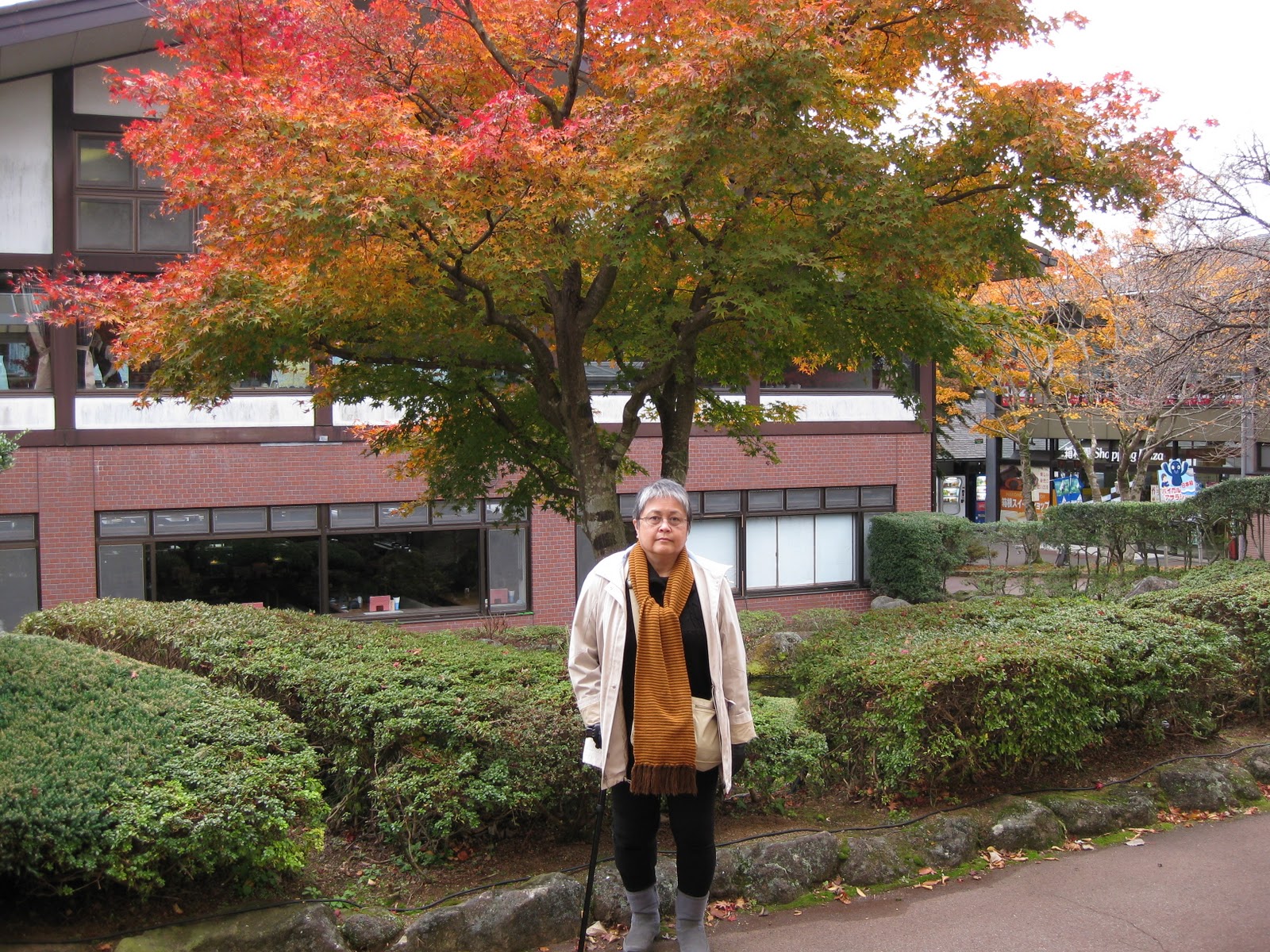
Hakone, a rustic but beautiful area in southeastern Japan, is a quaint onsen (hot spring) town and gateway to Mt. Fuji. Fall colors (koyo) are very beautiful with brilliant red and yellow leaves you can see if you travel Japan in November. On clear days, areas such as Mt. Komagatake and the Komagatake Ropeway, the Hakone Ropeway, and Lake Ashinoko are ideal spots for excellent views of Mt. Fuji.
Arriving by Shinkansen bullet train at Odawara station, proceed to the Hakone Tourist Information office in the station and get free maps and brochures on the Hakone area. The nice lady in the office even called our hotel to send a shuttle bus to pick us up.
If you decide to use the Odakyu Hakone Free pass, proceed to the Odakyu office in the station and purchase the 2-day(3900 Yen) or the 3-day(4,400 Yen) pass-good for unlimited travel on the Hakone Tozan railway, the Hakone Ropeway, the Hakone Tozan cable car, Hakone Tozan bus, and the Hakone sightseeing cruise, a great value for the money.
A recommended sightseeing route from Odawara station might be:
1. A train ride on the Hakone Tozan railway to Hakone Yumoto.
2. Then continue from Hakone Yumoto to Gora on the Hakone Tozan train.
3. Take the Hakone Tozan cable car from Gora to Sounzan for fall colors.
4. Take the Hakone Ropeway from Sounzan to Owakudani where you can see steam emitting from hellish fissures.
5. From Owakudani to Togendai on Hakone Ropeway where views of Mt. Fuji can be seen.
6. Ride aboard the Hakone Sightseeing cruise ship on Lake Ashinoko where more views of Mt. Fuji can be had until Moto Hakone.
7. From Moto Hakone, catch the Hakone Tozan bus to Hakone-en, where you can walk to the Komagatake station and ride the Komagatake Ropeway to Mt. Komagatake for more fabulous views of Mt. Fuji.
8. Upon returning to the Komagatake station and walking a short distance to Hakone-en, hop on the Hakone Tozan bus and either go to your hotel or back to Odawara station.
For more information please click on link to go to http://traveljapan-us.com/.
Saturday, December 25, 2010
Tengu

Tengu Restaurant Tokyo
Tengu is a chain of izakaya restaurants found all over Tokyo. I have been to a couple of them, but I find the one just outside the Shinjuku station convenient. It is located upstairs of the UniQlo store right near the station exit. We proceeded to have a great time eating some very tasty inexpensive dishes. This Tokyo restaurant offers yakitori (grilled chicken gizzards, along with regular chicken parts) 126 Yen per skewer, kari kari gobo salad (deep fried shaved burdock root on a tossed salad with fried shrimp) 500 Yen, cheese pizza 600 Yen. The restaurant serves the more traditional dishes like sashimi, salads, tempura, oysters, chicken katsu, to mention a few, all at a reasonable price. This Tokyo restaurant serves drinks that are quite reasonable too, with 180 ml glasses of sake' for 399 Yen, glasses of shochu for 400 Yen, and mugs of beer for 500 Yen. The izakaya is noisy with mostly working folks, but with super drinks and lots of great, inexpensive food, it's worth it. For more information on this topic or Japan, please go to http://traveljapan-us.com/.
Saturday, December 4, 2010
Sapporo Nijo Market


Just a few minutes walk from Tanukikoji Arcade in Sapporo, the Sapporo Nijo Market is an interesting place to visit. You will find the freshest fish, scallops, sea urchins, shrimp, squid, octopus and king, queen, and hairy crab. The taraba gani(king crab)of the highest quality can be found here from 5,000 yen to 7,000 yen, or more depending on size and quality. I personally purchased a very high quality large king crab, with all legs intact, hard shell and just caught for 7,000 yen. My purchase of king crab and other seafood items was made at the Maruichi Market from Mikami-san, but the vendors are very friendly, and if you buy enough you can bargain with them for a better price. Dried seafood is plentiful, and we just enjoyed the dried and smoked scallops, smoked octopus legs, dried squid, and some of the soy sauce prepared sea kelp.
We even had an early morning seafood breakfast at one of the restaurants in the fish market. At the Donburi Chaya restaurant I had the Kaisen assorted seafood bowl. 9 toppings including maguro(tuna)sashimi, salmon sashimi, ikura(salmon roe), hotate(scallop)sashimi, king crab meat, botan ebi(peony)shrimp, uni(sea urchin), egg roll, and yama imo(diced mountain yam) on a bed of delicious rice along with hot Japanese tea for 1,449 yen. You can try a steaming bowl of miso soup with crab inside as flavoring for an additional 200 yen. Awesome breakfast!
You can easily see why the Sapporo Nijo Market is a Travel Japan-US favorite.
Location: Just at the end of Tanukikoji Arcade on 2nd St. Fish vendors open at 7:00AM and close around 6:00PM. Restaurants open a little later.
For more information and pictures on Japan: http://travljpn.blogspot.com/. For other articles on Japan, please go to http://traveljapan-us.com/.
Subscribe to:
Posts (Atom)


 Posts
Posts


